| . |

Market Commentary 31477
May, 2019 Data:
Part 1
FORECASTS
12 MONTH FORECAST
The 12 month forecast for the S&P 500 Index is in the table at the top of this
page. Forecast-Chart.com is forecasting a Standard & Poor's 500 Stock Index
of 2703. The table shows a HDTFA of 364 which suggests that the June, 2020
S&P 500 could easily close anywhere between 3067 and 2339. Links to
Forecasts for twenty-two other stock indexes may be found by clicking Stock
Market Forecast at the top of any page.
BULL MARKET or BEAR MARKET?
An updated primary trend forecast for the U.S. Stock Market is provided to
subscribers only. A time delayed primary trend forecast is provided to non
subscribers. Artificial Intelligence is used to forecast major turning points in the
broad U.S. Stock Market. The forecast is either a Bull Market Signal (up) or a
Bear Market Signal (down). This mathematical system performed very well in a
one hundred year backtest and also in real time since going live in 2005. To get
the forecast signal for the broad U.S Stock Market, click Stock Market Forecast
at the top of any page. Then select the Bull Market & Bear Market Forecast.
10 YEAR FORECAST
Forecast-Chart.com publishes a Ten Year Forecast for the Standard & Poor's
500 Stock Index. The Ten Year Forecast estimates the probability that the S&P
500 equity index will achieve certain gain or loss benchmarks at a point in time
ten years in the future. For example, look at the top line of the table immediately
below this paragraph. Forecast-Chart.com is forecasting a probability of 5%
that the S&P 500 Index will be down at least 20% in 10 years (May, 2029 close
compared to May, 2019 close).
PROBABILITY
Down at least 20% 5%
Down at least 10% 6%
Down 8%
Up 92%
Up at least 10% 91%
Up at least 20% 90%
Up at least 30% 88%
Up at least 40% 85%
Up at least 50% 80%
Up at least 100% 63%
Up at least 150% 45%
Up at least 200% 17%
Over 110 YEARS of historical data was used to calculate the probabilities in the
table above. Dividends are not included. So you must add expected dividends
to the forecasted gain to estimate the total return for the equities represented
by this index. Each month, new data is entered into the forecasting model and
the S&P 500 is assigned a rank from 1 to 10. The best rank is 10 and the worst
is 1. That ranking determines the Ten Year Forecast for the Standard & Poor's
500 Stock Index . The data used in the forecasting model is updated monthly
and may change the forecast, particularly after substantial movements in the
S&P 500. The latest ranking of the Standard & Poor's 500 Stock Index is 7.
Forecast-Chart.com publishes a 10 Year Forecast for 12 of the 23 stock market
indexes covered at Forecast-Chart.com. The indexes with the highest
probability of gaining over 200% in the next 10 years are the Hang Seng and
the S&P TSX Index. The indexes with the lowest probability of gaining over
200% in the next 10 years are the S&P SmallCap 600, S&P MidCap 400,
Russell 2000, NASDAQ 100 and the Dow Industrial Average. To see these
forecasts, click the Stock Market Forecast link at the top of any page, then
select the index you are interested in.
The last time that the S&P 500 Index received the best rank (10) was 6/2009,
when the S&P 500 Index closed at 919. The last time that the S&P 500 Index
received a rank of 9 was 12/2012, when the S&P 500 Index closed at 1426. The
last time that the S&P 500 Index received the worst rank (1) was 10/2000, when
the S&P 500 Index closed at 1429. The last time that the S&P 500 Index
received a rank of 2 was 1/2001, when the S&P 500 Index closed at 1366. Last
month's close for the S&P 500 Index is in the Market Highlights section below.
Part 2
MARKET HIGHLIGHTS
All Time High 2924 (April, 2019)
May, 2019 close 2789
Decline From All Time High 5%
10 Year Return 203%
5 Year Low 1920 (September, 2015)
Gain From 5 Year Low 45%
The highest all time monthly close in the Standard & Poor's 500 Stock Index
was 2924 in April, of 2019. The May, 2019 close was 2789. That's a decline of
135 points or 5% below the S&P 500 Index all time high. The S&P 500 Index is
up 203% over the last 10 years. It has gained 3% over the last 12 months.
The May close was 134.87 points lower than the April, 2019 close of 2924,
resulting in a 4.61% decline for May.
The 5 year market low for the Standard & Poor's 500 Stock Index was 1920 in
September of 2015. The May, 2019 close at 2788.86 represents a 45% gain
since September, 2015.
Forecast-Chart.com's historical research covers the S&P 500 back to February,
1950. All calculations are based on the monthly market close in the Standard &
Poor's 500 Stock Index, excluding dividends.
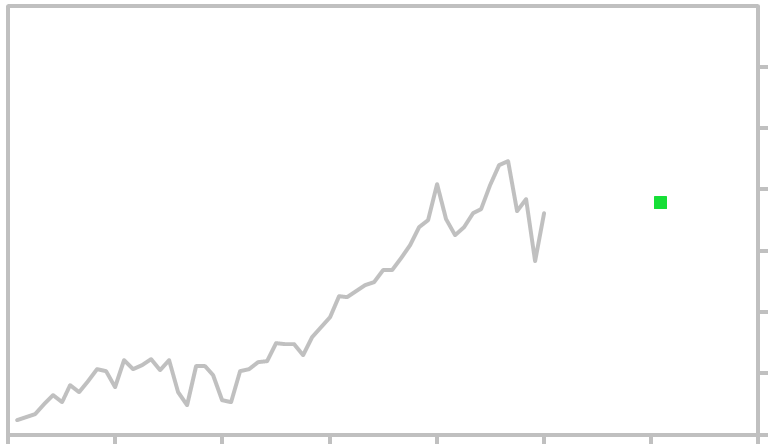
This page provides a five year chart and a forecast for the S&P 500 Index. For
links to longer term charts, look at the links under the five year chart (above).
One link opens a ten year chart. Another opens our longest term graph on the
S&P 500 Index. Just one glance at our long term charts can provide
tremendous insight into the historical trends of the financial markets. The table
above presents historical data on the Standard & Poor's 500 Stock Index
categorized by the months of the calendar.
Part 3
ROLLING RETURNS, 1950 - 2019: S&P 500 Index
Rolling Period Last / Percentile Best / Average / Worst
1 Year 3% / 32nd 53% / 9% / -45%
2 Year 16% / 46th 87% / 18% / -48%
4 Year 32% / 46th 172% / 38% / -39%
8 Year 107% / 63rd 272% / 85% / -41%
16 Year 189% / 52nd 946% / 233% / 24%
How do you read the table?
For example: Rolling 2 year period returns are shown on the second row. In the
latest rolling 2 year period, (6/2017 - 5/2019), the S&P 500 Index returned 16%.
That period scored in the 46th percentile, meaning that it scored better than
46% of all rolling 2 year periods since 1950. The Best rolling 2 Year period
since 1950 returned 87%. The worst returned -48%. The average rolling 2 year
period returned 18%.
What is a rolling period?
It's an overlapping period in a data base. For example: In the 2 year period
included in 2000 - 2001, there are 13 complete rolling 12 Month Periods. The
first is January, 2000 - December, 2000. The second is February, 2000 -
January, 2001. The third is March, 2000 - February, 2001 and so on. The last
complete rolling 12 Month Period in the 2000 - 2001 period is January, 2001 -
December, 2001.
How is this information useful?
Best and worst case scenarios may be estimated based on historical facts.
Also, the relationship of the periods is sometimes very helpful. Suppose that the
worst rolling 8 year period in the last 50 years returned -30%. Suppose also
that the latest 4 year period has returned -50%. Market psychology at this point
may be one of great fear or possibly even panic. If the market stays flat for 4
more years, it will break the 8 year decline record by a whopping 20%! (-50%
minus -30% equals -20%.) 50 plus year records are not often broken. That
provides reason to hope that the market will recover that 20% over the next 4
years. If it does, then the 8 year loss will be 30%. The longest index histories
are found in the DJIA, FTSE 100 with FT 30, DJTA, DJUA, S&P 500, & NASDAQ
100
The number of periods in each category for the S&P 500 Index are as follows:
1 Year: 821
2 Year: 809
4 Year: 785
8 Year: 737
16 Year: 641
Dividends are not included.
Updated Tuesday, June 25, 2019.
SignalTrend Inc. 2008 - 2019; All rights reserved.
_____________________________________________________________
Report a Problem with this Page Contact Us Privacy Policy Terms of Use/Disclosure
May, 2019 Data:
Part 1
FORECASTS
12 MONTH FORECAST
The 12 month forecast for the S&P 500 Index is in the table at the top of this
page. Forecast-Chart.com is forecasting a Standard & Poor's 500 Stock Index
of 2703. The table shows a HDTFA of 364 which suggests that the June, 2020
S&P 500 could easily close anywhere between 3067 and 2339. Links to
Forecasts for twenty-two other stock indexes may be found by clicking Stock
Market Forecast at the top of any page.
BULL MARKET or BEAR MARKET?
An updated primary trend forecast for the U.S. Stock Market is provided to
subscribers only. A time delayed primary trend forecast is provided to non
subscribers. Artificial Intelligence is used to forecast major turning points in the
broad U.S. Stock Market. The forecast is either a Bull Market Signal (up) or a
Bear Market Signal (down). This mathematical system performed very well in a
one hundred year backtest and also in real time since going live in 2005. To get
the forecast signal for the broad U.S Stock Market, click Stock Market Forecast
at the top of any page. Then select the Bull Market & Bear Market Forecast.
10 YEAR FORECAST
Forecast-Chart.com publishes a Ten Year Forecast for the Standard & Poor's
500 Stock Index. The Ten Year Forecast estimates the probability that the S&P
500 equity index will achieve certain gain or loss benchmarks at a point in time
ten years in the future. For example, look at the top line of the table immediately
below this paragraph. Forecast-Chart.com is forecasting a probability of 5%
that the S&P 500 Index will be down at least 20% in 10 years (May, 2029 close
compared to May, 2019 close).
PROBABILITY
Down at least 20% 5%
Down at least 10% 6%
Down 8%
Up 92%
Up at least 10% 91%
Up at least 20% 90%
Up at least 30% 88%
Up at least 40% 85%
Up at least 50% 80%
Up at least 100% 63%
Up at least 150% 45%
Up at least 200% 17%
Over 110 YEARS of historical data was used to calculate the probabilities in the
table above. Dividends are not included. So you must add expected dividends
to the forecasted gain to estimate the total return for the equities represented
by this index. Each month, new data is entered into the forecasting model and
the S&P 500 is assigned a rank from 1 to 10. The best rank is 10 and the worst
is 1. That ranking determines the Ten Year Forecast for the Standard & Poor's
500 Stock Index . The data used in the forecasting model is updated monthly
and may change the forecast, particularly after substantial movements in the
S&P 500. The latest ranking of the Standard & Poor's 500 Stock Index is 7.
Forecast-Chart.com publishes a 10 Year Forecast for 12 of the 23 stock market
indexes covered at Forecast-Chart.com. The indexes with the highest
probability of gaining over 200% in the next 10 years are the Hang Seng and
the S&P TSX Index. The indexes with the lowest probability of gaining over
200% in the next 10 years are the S&P SmallCap 600, S&P MidCap 400,
Russell 2000, NASDAQ 100 and the Dow Industrial Average. To see these
forecasts, click the Stock Market Forecast link at the top of any page, then
select the index you are interested in.
The last time that the S&P 500 Index received the best rank (10) was 6/2009,
when the S&P 500 Index closed at 919. The last time that the S&P 500 Index
received a rank of 9 was 12/2012, when the S&P 500 Index closed at 1426. The
last time that the S&P 500 Index received the worst rank (1) was 10/2000, when
the S&P 500 Index closed at 1429. The last time that the S&P 500 Index
received a rank of 2 was 1/2001, when the S&P 500 Index closed at 1366. Last
month's close for the S&P 500 Index is in the Market Highlights section below.
Part 2
MARKET HIGHLIGHTS
All Time High 2924 (April, 2019)
May, 2019 close 2789
Decline From All Time High 5%
10 Year Return 203%
5 Year Low 1920 (September, 2015)
Gain From 5 Year Low 45%
The highest all time monthly close in the Standard & Poor's 500 Stock Index
was 2924 in April, of 2019. The May, 2019 close was 2789. That's a decline of
135 points or 5% below the S&P 500 Index all time high. The S&P 500 Index is
up 203% over the last 10 years. It has gained 3% over the last 12 months.
The May close was 134.87 points lower than the April, 2019 close of 2924,
resulting in a 4.61% decline for May.
The 5 year market low for the Standard & Poor's 500 Stock Index was 1920 in
September of 2015. The May, 2019 close at 2788.86 represents a 45% gain
since September, 2015.
Forecast-Chart.com's historical research covers the S&P 500 back to February,
1950. All calculations are based on the monthly market close in the Standard &
Poor's 500 Stock Index, excluding dividends.
This page provides a five year chart and a forecast for the S&P 500 Index. For
links to longer term charts, look at the links under the five year chart (above).
One link opens a ten year chart. Another opens our longest term graph on the
S&P 500 Index. Just one glance at our long term charts can provide
tremendous insight into the historical trends of the financial markets. The table
above presents historical data on the Standard & Poor's 500 Stock Index
categorized by the months of the calendar.
Part 3
ROLLING RETURNS, 1950 - 2019: S&P 500 Index
Rolling Period Last / Percentile Best / Average / Worst
1 Year 3% / 32nd 53% / 9% / -45%
2 Year 16% / 46th 87% / 18% / -48%
4 Year 32% / 46th 172% / 38% / -39%
8 Year 107% / 63rd 272% / 85% / -41%
16 Year 189% / 52nd 946% / 233% / 24%
How do you read the table?
For example: Rolling 2 year period returns are shown on the second row. In the
latest rolling 2 year period, (6/2017 - 5/2019), the S&P 500 Index returned 16%.
That period scored in the 46th percentile, meaning that it scored better than
46% of all rolling 2 year periods since 1950. The Best rolling 2 Year period
since 1950 returned 87%. The worst returned -48%. The average rolling 2 year
period returned 18%.
What is a rolling period?
It's an overlapping period in a data base. For example: In the 2 year period
included in 2000 - 2001, there are 13 complete rolling 12 Month Periods. The
first is January, 2000 - December, 2000. The second is February, 2000 -
January, 2001. The third is March, 2000 - February, 2001 and so on. The last
complete rolling 12 Month Period in the 2000 - 2001 period is January, 2001 -
December, 2001.
How is this information useful?
Best and worst case scenarios may be estimated based on historical facts.
Also, the relationship of the periods is sometimes very helpful. Suppose that the
worst rolling 8 year period in the last 50 years returned -30%. Suppose also
that the latest 4 year period has returned -50%. Market psychology at this point
may be one of great fear or possibly even panic. If the market stays flat for 4
more years, it will break the 8 year decline record by a whopping 20%! (-50%
minus -30% equals -20%.) 50 plus year records are not often broken. That
provides reason to hope that the market will recover that 20% over the next 4
years. If it does, then the 8 year loss will be 30%. The longest index histories
are found in the DJIA, FTSE 100 with FT 30, DJTA, DJUA, S&P 500, & NASDAQ
100
The number of periods in each category for the S&P 500 Index are as follows:
1 Year: 821
2 Year: 809
4 Year: 785
8 Year: 737
16 Year: 641
Dividends are not included.
Updated Tuesday, June 25, 2019.
SignalTrend Inc. 2008 - 2019; All rights reserved.
_____________________________________________________________
Report a Problem with this Page Contact Us Privacy Policy Terms of Use/Disclosure
Monthly close for the S&P 500 Stock Index is plotted in gray. The forecast for the target month is
shown in green. See other links related to this stock index below.
shown in green. See other links related to this stock index below.
| Standard & Poor's 500 Stock Index - 5 Year History |
| 2800 |
| 3050 |
| 3300 |
| 2550 |
| 2050 |
| 2300 |
S&P 500 Index Forecast
| 1800 |
| ||||||||||||||||||||||||||||||||||||||||||||||||||||||||||||||||||||||
Stock Market Forecast: S&P 500 Stock Index





1/14
| 1/2015 |
| 1/2016 |
1/2017
| 1/2018 |
| 1/2019 |
| 1/2020 |
| 1/21 |
| ||||||||||||||||